
The Limits of Grievance Politics
The latest Roy Morgan poll shows One Nation falling from its peak of 31.5% down to 22.5%. That represents a nine-point drop across two weeks. This follows last week’s polling, where both Newspoll and the RedBridge/Accent Research poll already showed One Nation slipping by two points. Newspoll had One Nation down to 29%, while RedBridge/Accent had One Nation on 29% after falling from 31%. Most of the lost primary support in the Roy Morgan poll has moved into the Independents and Others category, while some has gone toward the L-NP Coalition. Labor’s primary vote has remained largely unchanged and sits at 28%.
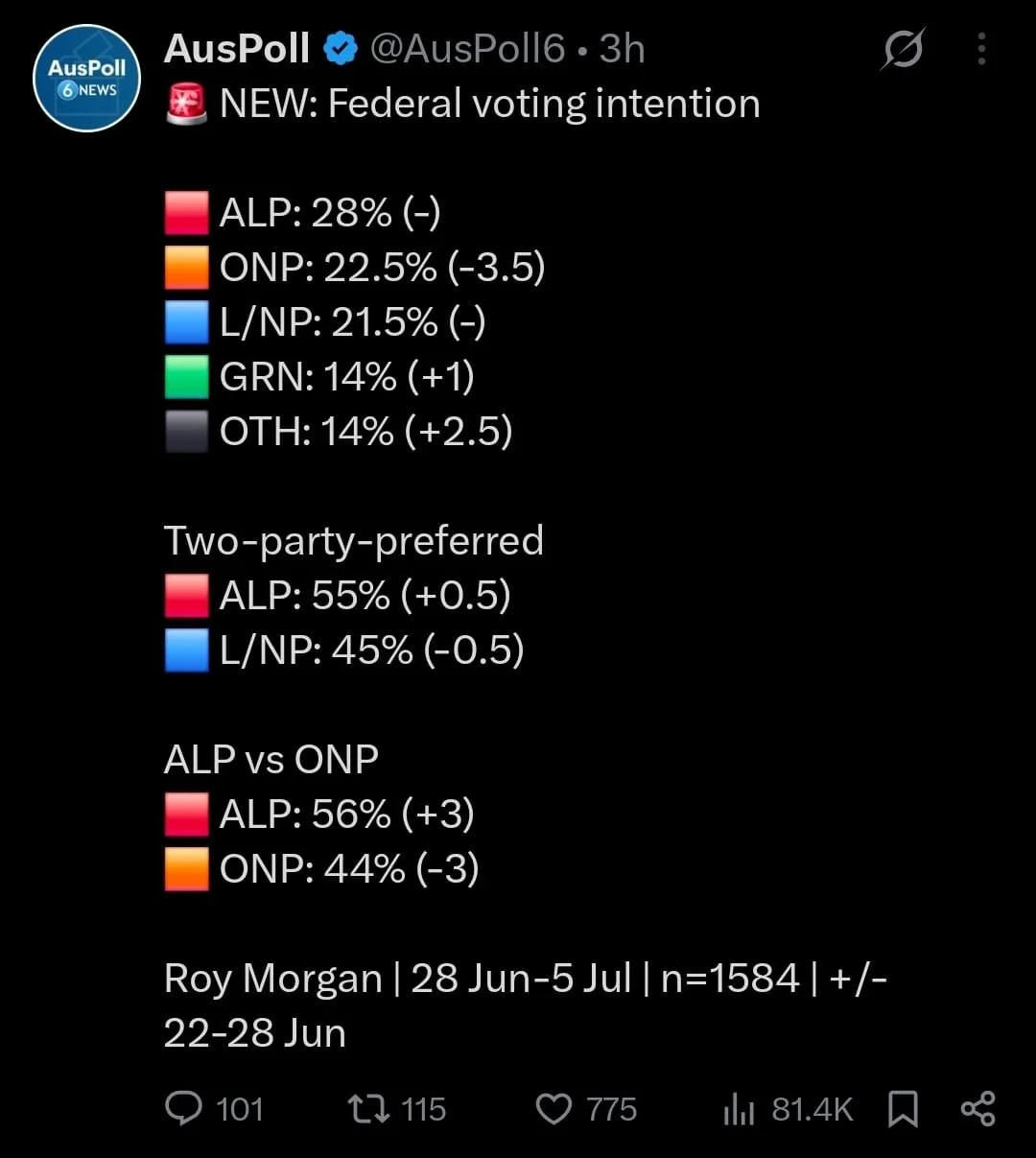
Much of the commentary around this drop has focused on Pauline Hanson’s comments about monoculturalism at the National Press Club. The reality is more straightforward.
One Nation has spent three decades positioning itself as the party willing to say plainly that high levels of migration and official multiculturalism have created serious problems for housing, wages, infrastructure and social cohesion. The people who pushed its numbers up to 31.5% were responding to those visible pressures. They were not encountering the party’s core positions for the first time and deciding they had made a mistake.
The sharper losses came from other directions. The paid parental leave comments created problems with families who are already struggling with the cost of raising children. The association with Gina Rinehart’s public remarks added another layer of friction. There was also a clear reaction to the sense that Pauline was taking a dismissive view of Gen Y and Gen Z. These issues landed with younger voters and with people who had been willing to support One Nation on migration but wanted to see the party address the full range of pressures affecting working Australians.
Voters will back One Nation when migration feels like the central issue driving down their living standards. They begin to drift when the party appears to have little concrete to offer on the other things that are making life harder. Cost of living, the ability to buy a home, and the practical question of whether people can afford to have children all sit alongside migration as daily realities. When those issues are left unaddressed, support becomes conditional rather than solid.
Grievance alone has limits as a political foundation. There is widespread and legitimate anger about the scale of migration, the failure of governments to protect the interests of existing citizens, and the broader sense that the country is changing in ways that leave ordinary people worse off. That anger can bring people to a party quickly. What it does not do on its own is create lasting attachment. People who step outside the major parties are not simply looking for validation of their frustration, they are looking for something that feels like it can actually change the direction of the country
This is where the question of seriousness becomes important. Voting for One Nation still carries a degree of risk for many Australians. It feels like a break from the established political class. When people take that step, they need to see that the party understands the weight of what it is asking. That means showing up consistently in parliament. It means treating staffing, candidate selection, policy development and public communication as responsibilities rather than ongoing protest activities. Some supporters are already questioning whether the party understands the mantle of responsibility that comes with the level of support it is now receiving.
The migration debate itself shows where this matters most. It is possible to build a large audience by describing the failures of current policy on borders, housing pressure and wage suppression. A movement that wants to last needs to go further. It needs to speak clearly about what it is trying to protect and what kind of country it wants Australia to remain. That includes talking about the culture, the history and the conditions under which Australian families can actually build stable lives. The argument against mass migration becomes stronger when it is connected to a clear picture of stability, cohesion and opportunity for the people already here.
This is where practical framing makes a difference. On families, the issue is not just the design of paid parental leave. Many Australians cannot afford to have children in the first place because wages have been held down by high migration and housing costs have become extreme. Policies such as income splitting and genuine pro-natalist measures speak to the actual constraints rather than adding more temporary payments while the underlying problems continue.
On young Australians, the response needs to be equally direct. Claims that Gen Y and Gen Z are lazy ignore the reality that large numbers of them are struggling to get stable entry-level work and career progression. Employers have become accustomed to sourcing cheaper labour from overseas under weak enterprise agreements. The practical response is to tighten the rules around those agreements and give Australian workers, particularly younger ones, a clearer path into decent employment instead of treating them as an afterthought.
One Nation still has a significant opening in Australian politics. Trust in the major parties remains low and the underlying frustrations with migration, housing and living standards have not gone away. At the same time, recent polling is a reminder that support built on protest can move in both directions. It can rise quickly when people feel ignored by the established system, but it can also recede if the party receiving that support does not demonstrate that it can move beyond anger into something more substantial.
The weakness exposed by this polling goes well beyond One Nation. Too much of the right treats migration as if naming the problem is the same as offering the country a future. Australians can already see the pressure on housing, wages, schools, infrastructure and social cohesion. Repeating the grievance without tying it to a positive national project leaves voters with a complaint and little reason to believe anything will actually be rebuilt.
Any serious movement has to understand what this moment requires. Australian voters are looking for more than a running commentary on decline. They want a vision of the future they can recognise and rally around: a country that works for its own citizens, protects its culture and social cohesion, makes family formation possible, rewards work, and treats national continuity as something worth defending.
Migration matters because it is eroding the basic conditions of national life: affordable homes, decent work, family formation, social trust, and a country that still feels like it belongs to its own people.
The party that can connect the problem to Australian revival will have a much stronger claim than the party that merely complains about decline.