
The Limits of Grievance Politics
Recent polling does not mean One Nation’s rise is over, but it does expose a real weakness. Voters may reward a party for naming the pressure caused by migration, housing costs and national decline, but support becomes less secure when that party cannot connect the problem to a serious vision of Australian revival.
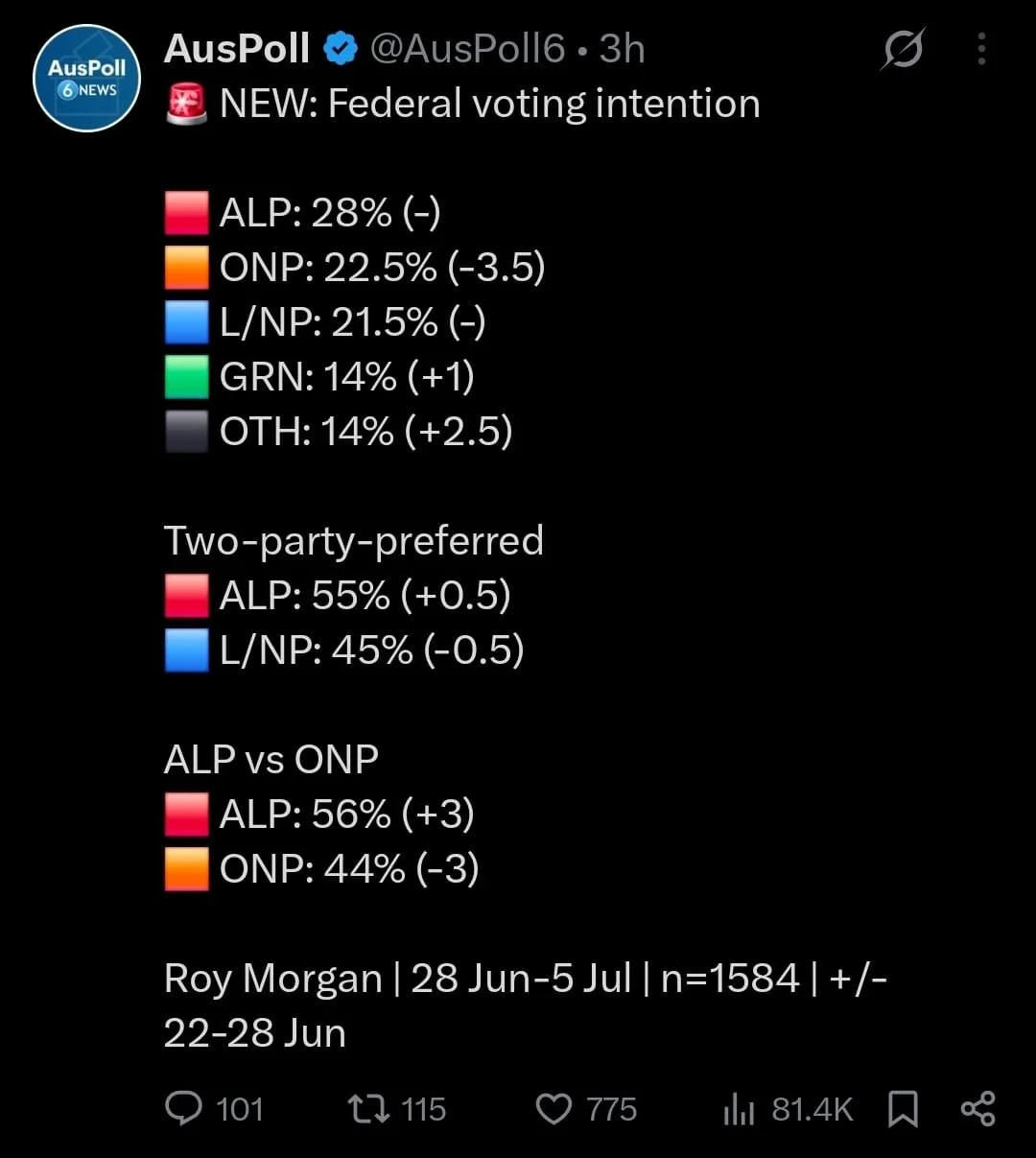
The latest Roy Morgan poll shows One Nation falling from its peak of 31.5% down to 22.5%. That represents a nine-point drop across two weeks. This follows last week’s polling, where both Newspoll and the RedBridge/Accent Research poll already showed One Nation slipping by two points. Newspoll had One Nation down to 29%, while RedBridge/Accent had One Nation on 29% after falling from 31%. Most of the lost primary support in the Roy Morgan poll has moved into the Independents and Others category, while some has gone toward the L-NP Coalition. Labor’s primary vote has remained largely unchanged and sits at 28%.
Much of the commentary around this drop has focused on Pauline Hanson’s comments about monoculturalism at the National Press Club. The reality is more straightforward.
One Nation has spent three decades positioning itself as the party willing to say plainly that high levels of migration and official multiculturalism have created serious problems for housing, wages, infrastructure and social cohesion. The people who pushed its numbers up to 31.5% were responding to those visible pressures. They were not encountering the party’s core positions for the first time and deciding they had made a mistake.
The sharper losses came from other directions. The paid parental leave comments created problems with families who are already struggling with the cost of raising children. The association with Gina Rinehart’s public remarks added another layer of friction. There was also a clear reaction to the sense that Pauline was taking a dismissive view of Gen Y and Gen Z. These issues landed with younger voters and with people who had been willing to support One Nation on migration but wanted to see the party address the full range of pressures affecting working Australians.
Voters will back One Nation when migration feels like the central issue driving down their living standards. They begin to drift when the party appears to have little concrete to offer on the other things that are making life harder. Cost of living, the ability to buy a home, and the practical question of whether people can afford to have children all sit alongside migration as daily realities. When those issues are left unaddressed, support becomes conditional rather than solid.
Grievance alone has limits as a political foundation. There is widespread and legitimate anger about the scale of migration, the failure of governments to protect the interests of existing citizens, and the broader sense that the country is changing in ways that leave ordinary people worse off. That anger can bring people to a party quickly. What it does not do on its own is create lasting attachment. People who step outside the major parties are not simply looking for validation of their frustration, they are looking for something that feels like it can actually change the direction of the country
This is where the question of seriousness becomes important. Voting for One Nation still carries a degree of risk for many Australians. It feels like a break from the established political class. When people take that step, they need to see that the party understands the weight of what it is asking. That means showing up consistently in parliament. It means treating staffing, candidate selection, policy development and public communication as responsibilities rather than ongoing protest activities. Some supporters are already questioning whether the party understands the mantle of responsibility that comes with the level of support it is now receiving.
The migration debate itself shows where this matters most. It is possible to build a large audience by describing the failures of current policy on borders, housing pressure and wage suppression. A movement that wants to last needs to go further. It needs to speak clearly about what it is trying to protect and what kind of country it wants Australia to remain. That includes talking about the culture, the history and the conditions under which Australian families can actually build stable lives. The argument against mass migration becomes stronger when it is connected to a clear picture of stability, cohesion and opportunity for the people already here.
This is where practical framing makes a difference. On families, the issue is not just the design of paid parental leave. Many Australians cannot afford to have children in the first place because wages have been held down by high migration and housing costs have become extreme. Policies such as income splitting and genuine pro-natalist measures speak to the actual constraints rather than adding more temporary payments while the underlying problems continue.
On young Australians, the response needs to be equally direct. Claims that Gen Y and Gen Z are lazy ignore the reality that large numbers of them are struggling to get stable entry-level work and career progression. Employers have become accustomed to sourcing cheaper labour from overseas under weak enterprise agreements. The practical response is to tighten the rules around those agreements and give Australian workers, particularly younger ones, a clearer path into decent employment instead of treating them as an afterthought.
One Nation still has a significant opening in Australian politics. Trust in the major parties remains low and the underlying frustrations with migration, housing and living standards have not gone away. At the same time, recent polling is a reminder that support built on protest can move in both directions. It can rise quickly when people feel ignored by the established system, but it can also recede if the party receiving that support does not demonstrate that it can move beyond anger into something more substantial.
The weakness exposed by this polling goes well beyond One Nation. Too much of the right treats migration as if naming the problem is the same as offering the country a future. Australians can already see the pressure on housing, wages, schools, infrastructure and social cohesion. Repeating the grievance without tying it to a positive national project leaves voters with a complaint and little reason to believe anything will actually be rebuilt.
Any serious movement has to understand what this moment requires. Australian voters are looking for more than a running commentary on decline. They want a vision of the future they can recognise and rally around: a country that works for its own citizens, protects its culture and social cohesion, makes family formation possible, rewards work, and treats national continuity as something worth defending.
Migration matters because it is eroding the basic conditions of national life: affordable homes, decent work, family formation, social trust, and a country that still feels like it belongs to its own people.
The party that can connect the problem to Australian revival will have a much stronger claim than the party that merely complains about decline.

Conservatives Still Do Not Understand Power
The Giggle decision represents far more than a legal dispute over an app. It marks another institutional victory in a much larger struggle over culture, power, and the future shape of Western society.
The Federal Court has ruled in favour of transgender female Roxanne Tickle, dismissing an appeal brought by the female-only Giggle app and reinforcing a broader legal interpretation of the word “woman” under Australian law. The case centred on whether a biological male who identifies as female and has undergone gender reassignment could lawfully be excluded from a platform explicitly designed as a space for women.
The practical implication of the ruling, in the eyes of many Australians, is that biological sex has increasingly been subordinated to gender identity within parts of Australian law. Critics of the decision argue that the Federal Court has effectively opened the door for biological males identifying as women, including those who have undergone gender reassignment procedures, to access female-only spaces while simultaneously eroding any fixed legal definition of what a woman actually is.
In short, Eunuchs with a diagnosed mental disorder — as listed in the DSM-5-TR under gender dysphoria — have been given a green light to enter female-only spaces, and the federal courts have decided that real women don’t exist.
For many women, and for many ordinary Australians watching these developments unfold, that represents a profound civilisational shift rather than a narrow technical legal dispute.
People can rage about the judgment itself, debate its scope, or argue over the downstream implications for women and female-only spaces, but the deeper issue sits well beyond this individual case. The ruling is a reflection of institutional power, ideological capture, and a political class that still fundamentally misunderstands how modern politics actually functions.
For most of modern political history, the Right understood the importance of institutions. Conservatives knew civilisations are maintained through cultural continuity, legal traditions, universities, churches, bureaucracies, courts, and inherited social norms. They knew institutions shape nations across generations.
What changed was the rise of a modern conservative mindset that treated institutional retreat as strategic realism. As institutions drifted left, much of the Right simply wrote them off as lost and walked away. Universities became hostile, so conservatives told young people to avoid them. Bureaucracies turned ideological, so engagement gave way to outsider resentment. Cultural institutions were captured, so the response was withdrawal instead of counter-occupation.
That approach proved catastrophic. Vacuums don’t stay empty and institutions abandoned by one side are filled by the other.
Even worse, many conservatives convinced themselves certain institutions were untouchable. Courts, in particular, were seen as sacred pillars of impartiality that nobody would dare politicise.
This ignores a basic truth: large parts of the activist Left reject Western civilisational norms outright. They see those traditions, hierarchies, and moral frameworks as obstacles to be dismantled, not preserved. Once you grasp that, it’s obvious why every institution — including the judiciary — became contested ground.
The modern Left understood decades ago that power flows through institutions: judiciary, academia, media, public administration, regulators, arts bodies, and the credentialing systems that shape elite opinion. Control those, and society eventually bends to your definitions.
The modern Right, by contrast, responded with retreat and escapism. Every call for young conservatives to skip university, “just become tradies,” or retreat into parallel societies is effectively a call to surrender.
Universities aren’t just classrooms. They are the pipeline feeding every other layer of power — future lawyers, judges, journalists, bureaucrats, executives, teachers, and politicians. Abandon them and you abandon the future ruling class.
That’s exactly why rulings like this come as no surprise.
Federally appointed judges don’t just apply the law mechanically. They define its scope. Their interpretations shape how statutes work in practice, how future cases are argued, how legislation is drafted, and how society understands contested concepts. Judicial appointments echo for decades.
The public barely notices. Minor parties barely notice. Attorneys-General make these appointments with almost no sustained scrutiny outside the legal bubble, even though they can reshape society long after the government has gone.
The deeper frustration many Australians feel isn’t just the outcome. It’s the growing sense that large sections of institutional Australia operate from a narrow ideological framework while pretending to stand above politics.
This didn’t happen by accident.
Attorneys-General since Christian Porter have treated federal judicial appointments with astonishing complacency. Merit often seems secondary to box-ticking, factional balance, symbolism, or ideological comfort. Recent appointments frequently show judges elevated with limited senior counsel experience and clear pre-existing worldviews.
Judges are human. They bring assumptions, moral intuitions, and ideological priors into their rulings, especially on vague, politically charged social issues. Many in the federal judiciary also seem increasingly detached from core disciplines like criminal law, the traditional grounding of legal reasoning. When institutions become culturally uniform, dissenting views vanish.
The result is a judiciary that feels culturally and ideologically remote from ordinary Australians.
Conservatives now face a choice they’ve dodged for decades. Keep pretending institutions don’t matter, or accept what every serious political movement has always known: institutions determine civilisational direction.
Winning elections isn’t enough. A single term in government achieves little if universities, courts, bureaucracies, media, and the professional class remain hostile and keep reproducing the same worldview.
That’s why conservative victories across the West so often feel temporary and hollow. Governments change while the permanent institutional architecture stays intact.
Real change demands a long march through the institutions. It requires generations willing to enter law, academia, bureaucracy, media, culture, education, and public administration — knowing these spaces shape the nation’s future consciousness. Above all, it requires dropping the fantasy that neutrality still exists.
The Giggle ruling is no isolated anomaly. It is the predictable product of institutional momentum built over years across the West. Anyone shocked by it simply hasn’t been paying attention to where power actually resides.
The central political struggle of our era is no longer merely electoral. It is institutional, cultural, and generational. The side that commits to the long march — whether rewards come in five, twenty, or fifty years — is the side that will shape the civilisation its descendants inherit.
This demands a seriousness many still refuse to confront. Too many movements chase immediate gratification through one election win, one viral moment, or one parliamentary breakthrough. Real civilisational change unfolds across generations, often requiring decades of institutional persistence before cultural and political transformation becomes visible. Most who lay the foundations for that future will never personally experience the world they helped create. The struggle is generational by its very nature.
In many ways the task ahead echoes Ernest Shackleton’s famous recruitment ad — men wanted for a hazardous journey into bitter cold, darkness, and danger, with only honour if they succeed. The modern struggle across the West demands the same spirit: people willing to face social hostility, professional consequences, institutional exclusion, and years of defeat, knowing the fruits may belong to their children or grandchildren. It is a cause worth dedicating a life to.

An artistic visualization of the ad in London newspapers seeking explorers for Ernest Shackleton’s expedition aboard the Endurance
Many conservatives also misunderstand what victory looks like. A minor party in parliament is not victory. A temporary swing is not victory. A populist government lasting one or two terms is not victory. These are just tactical gains in a deeper war over culture, legitimacy, institutions, and national identity.
True victory comes when certain ideas become socially toxic. When embracing them carries real consequences, when families recoil in embarrassment, when destructive ideologies provoke the same instinctive revulsion once reserved for extremism and decay. Such a cultural shift requires discipline, institutional persistence, long-term thinking, and generations willing to fight battles they may never personally win.
If conservatives keep refusing to engage with institutional power, they will keep losing, no matter how many elections they scrape together along the way.
The people who understood that institutions define reality have already been acting on that truth for decades. They are winning.

Submission to the Senate Select Committee on Productivity
The current economic model has failed the people it was supposed to serve. Australians are being asked to accept a larger economy while falling behind in their own country, with rising costs, declining living standards, and housing slipping further out of reach. This submission sets out why that outcome is not accidental, why it is being driven by policy choices, and why reversing it requires ending the current approach and putting Australians first.
opening statement
Thank you for the opportunity to appear today.
Australians were promised prosperity, but what they have experienced is decline.
The gap between what was promised and what has been delivered sits at the centre of this discussion.
The current economic model has failed the people it was supposed to serve, yet Australians are still being asked to accept a bigger economy while they themselves fall behind in their own country.
Living standards have stalled or gone backwards, housing has moved out of reach for large parts of the population, and the cost of living continues to rise faster than incomes. Australians are getting poorer inside an economy that is still being described as a success. It is anything but.
A key driver of that outcome has been the mass migration experiment, and it has failed on every metric. It has not delivered prosperity where it matters, and it has made things worse for everyday Australians. Headline GDP has been nudged higher through deliberate efforts to expand the size of the economy, but GDP per person has gone backwards and people’s lives have suffered as a result.
Despite this, the economic establishment remains committed to continuing an approach that has already failed in practice and is now being felt in the daily lives of Australians.
Aggregate GDP should not be treated as the primary measure of a nation’s success. If the price of higher GDP is turning Australia into something like a Mos Eisley cantina, then the problem is not that we need to manage migration better, it is that we are chasing the wrong objective altogether.
A country is not an abstract economic zone whose purpose is to maximise output at any cost. It is a place with a history, a culture, and a people who have a right to continuity and stability in their own communities.
Once you accept the premise that any level of change is justified if it lifts a headline number, you have already conceded that the character of the nation is expendable. I reject that completely. Economic performance matters, but it does not override the right of Australians to preserve a country that remains recognisable, cohesive, and their own.
Australia is stagnating while the mass migration experiment continues. that alone proves the model has failed.
You cannot fix productivity, housing, or the cost of living while continuing to increase population under the same approach, because every one of those pressures is being intensified at the same time as policymakers claim to be solving them.
Australians are not widgets. They are not flesh-covered units of economic output to be scaled up or scaled down to improve a graph.
A nation is its people, not a set of numbers, yet the system we are operating under continues to expand without regard for the consequences, and Australians are carrying the cost of that expansion every day.
If this inquiry is serious about productivity, then it has to confront the structure that is producing these outcomes.
That means ending the mass migration experiment, resetting the model, and putting Australians first.
Full Submission to the Senate Select Committee on Productivity in Australia:
This submission focuses on paragraph B, which deals with a long-term national settlement strategy, and paragraph K, which allows for related matters. Both lead back to the same issue. You cannot deal with productivity, housing, infrastructure, or regional development without addressing the impact of mass migration.
Australia is now confronting the consequences of a failed policy model that has not delivered rising living standards for its people and is actively contributing to their decline. Governments have relied on high migration and rapid population growth to make the economy appear stronger than it is. That headline growth has been used as proof that the system is working. It has not. The policy was sold on the promise that it would lift productivity and improve living standards. It has failed to do both. Productivity has stalled and outcomes for Australians, measured per person, have gone backwards.
Australia is stagnating while migration continues at elevated levels. That alone clearly demonstrates that the mass migration experiment has failed, was always going to fail, and must be abandoned immediately.
When a system delivers worse outcomes for the people living under it, it is failing. GDP per person has gone backwards over extended periods, housing has become unaffordable for a growing share of Australians, infrastructure is under strain, and the cost of living continues to rise faster than incomes. These outcomes flow directly from the policy settings that have been chosen.
The current model rests on a simple idea. Bring in more people, increase demand, and the economy grows. That idea is flawed. It substitutes population growth for real productivity and calls it success, even when Australians are worse off.
Housing shows this clearly. Demand has been pushed higher year after year. Access to stable and affordable housing has deteriorated. These outcomes are driven by decisions that deliberately increase demand without regard for the consequences.
The impact on productivity follows directly. Growth driven by population rather than output per person weakens the system. Workers face higher costs and fewer opportunities to get ahead. Capital flows into land and housing instead of productive investment. Businesses operate under higher costs and tighter margins. Over time, this erodes the strength of the economy.
The policy implication is straightforward. You do not solve this by trying to absorb ever-increasing population levels through changes to the built environment. Turning suburbs into high-density, mass-produced dog boxes embeds the problem and shifts the cost onto Australians in their daily lives.
The only workable solution is to address the source of the problem. That means ending mass migration in the interests of the country. Without that, every other policy will be a stopgap while the system continues to add fuel to the fire.
This goes beyond economics. It speaks to the nature of the country itself. Australians expect continuity in their homes, their neighbourhoods, and their national identity. They do not expect a country that is constantly reshaped by policy decisions outside their control.
The whole world comes here, which raises a basic question about limits and continuity. If everyone can become part of the same system without constraint, the character of that system changes. A civilisation that expands without limit cannot remain stable.
Australians are governed by an establishment fixated on flawed economic models that treat expansion as an end in itself. This is wrong. It hollows out the country and leaves behind an empty shell, where a nation once defined by its people, its culture, and its history is reduced to numbers on a spreadsheet.
This approach reduces Australians to inputs in a system designed to push headline figures higher. When growth slows, the response is to increase scale rather than fix the underlying problems. The result is a model that prioritises expansion over outcomes and ignores whether living standards are improving.
Australians are not widgets. They are not flesh-covered units of economic output to be scaled up or scaled down to improve a graph. A functioning economy matters, but it is not the sole measure of a nation’s success, and when policy treats people as interchangeable inputs rather than citizens with a stake in the country, it loses its purpose and drives long-term decline.
That decline is already visible. Many individuals in Australia have lost a sense of meaning and direction because they are being pushed into a system that treats them as machines whose role is to generate ever-increasing output. The result is a culture that rewards short-term consumption and day-to-day living, which may improve headline GDP figures but leaves the country weaker.
Great civilizations do not operate like this. They lift people out of that abyss and give them something higher to aim at. That cannot happen if the country is run on the assumption that leaving the borders open and increasing population will somehow deliver prosperity, while GDP per person continues to fall and living standards continue to deteriorate.
A national settlement strategy cannot work under these conditions because spreading population across regions while continuing to increase it simply extends the same pressures rather than resolving them. Any serious long-term strategy has to focus on improving outcomes for Australians on a per-person basis, with higher living standards, lower costs, and a system that works in their favour, because without that focus the entire exercise becomes another attempt to manage the consequences of a model that is already failing.
That failure sits within a broader economic framework that prioritises scale and constant expansion without delivering results, and continuing along this path is not a sign of stability or prudence but an admission that the underlying problem is being avoided. Current settings are often treated as the safe option, yet rising costs, declining affordability, and weakening outcomes are steadily eroding economic and social stability and reducing the country’s ability to sustain itself over time.
Australia has reached a point where incremental change will not be enough. The path we are on leads to managed decline, and continuing along it will not stabilise the country, it will hollow it out over time. We are being asked to accept lower living standards, weaker communities, and a loss of continuity as the price of maintaining a model that no longer works. That is not a serious offer to the Australian people, and it is not a future that should be accepted.
What is required now is a decisive shift in direction that puts Australians first, restores a sense of ownership over this country, and rebuilds a system that serves its people rather than reducing them to inputs within it.
This will require political courage, because it means stepping away from a framework that has dominated for decades and confronting the reality that it has failed. It means choosing to lead rather than manage outcomes, and acting in the long-term interests of the country even when that breaks with established thinking.
There is no easy path from here, but there is a necessary one. The task is not to manage decline or to make it appear less severe. The task is to turn the country around, restore its direction, and ensure that Australia remains a nation that its people recognise, can belong to, and can pass on intact.
Recommendations
I recommend that the Committee endorse the following:
Formally acknowledge that mass migration has failed as a productivity strategy and is driving declining outcomes for Australians on a per-person basis.
Commit to a substantial and sustained reduction in net overseas migration to levels that serve the long-term interests of Australians, not short-term economic optics.
Establish as a core policy principle that improving living standards for Australians on a per-person basis takes priority over aggregate economic growth.
Replace aggregate GDP as the primary measure of economic success with metrics that reflect real outcomes for Australians, including GDP per capita, real wage growth, and housing affordability.
End demand-side housing policies that inflate prices and increase competition against Australians, including access by non-citizens to government-backed housing schemes.
Direct all taxpayer-funded housing, infrastructure, and social support policies toward Australian citizens as a first priority.
Recognise migration-driven demand as a central cause of housing unaffordability, infrastructure strain, and declining productivity, and treat it accordingly in all future policy design.
Undertake a full structural reset of the current economic model, with a clear mandate to move away from population-driven growth and toward a system that delivers rising living standards for Australians.
Yours sincerely,
Brian Marlow
Founder and Director - Revive Australia
Our Mission
Australians can see that something is not right. Living standards are under pressure, institutions are losing trust, and the country feels less stable than it once did. Revive Australia exists to confront these problems directly, to challenge the political class that allowed them to emerge, and to build a movement focused on restoring strength, sovereignty, and long-term prosperity for Australians.
The case for a new political movement to restore Australia’s strength, stability, and direction
Australia is sleeping
And it is plagued by nightmares. Mass immigration at catastrophic levels. Threats to sovereignty and security from within and without. The erosion of national identity and culture. Collapse and capture of institutions. Attacks on freedom of speech and civil liberties.
Revive Australia’s mission is to wake Australia up.
We are a political organisation focused on setting Australia back on the path to power and prosperity.
An Australia for Australians, that puts Australia First, that knows itself, and knows what has to be done to secure its own existence.
Our current political establishment cannot do this. They are crippled by a crisis of competence brought on by decades of intellectual and political stagnation. They have no interest in changing our country for the better. Their only interest is in remaining as the establishment. They can achieve this by simply pandering to narrow interest groups, corporate lobbyists, their allies in the media, and the growing cohorts of new migrants.
We need a new type of politics. One that does not take the path of least resistance. One that is willing to climb a mountain.
That’s what Revive Australia is here to do.
To find like minded Australians and connect them with each other.
To support campaigns that change the trajectory Australia is on.
To educate and inform people on the issues that other institutions are too scared, or too compromised to mention.
The journey to a New Australia will be long, it will not be easy. There are no simple solutions. No one is coming to save us. Every Australian who loves their country has to work together, and work hard. The first step on that journey – is to wake up.
Revive Australia.